Book Review: Vibe Coding by Gene Kim and Steve Yegge
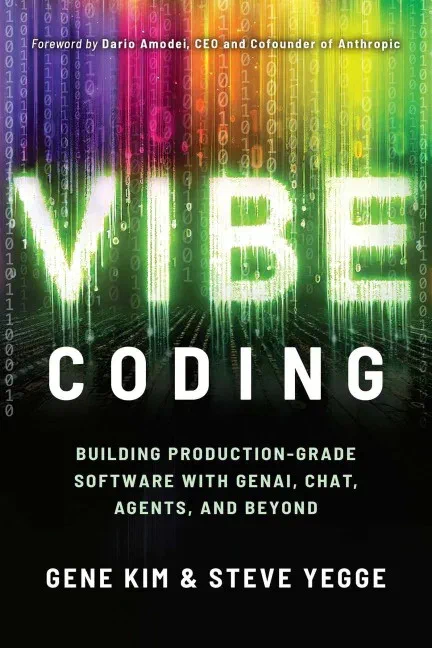
I ordered this book with a degree of skepticism already in place. Vibe coding as a concept is interesting, but the field is moving so fast that a published book on the topic risks being partly outdated before it even ships. What I was hoping for was something above the daily churn: general concepts, durable mental models, a sharper way to think about integrating AI tools into how I actually work. What I got was something more uneven than that.
The Authors
Gene Kim is the co-author of The Phoenix Project, The DevOps Handbook, and The Unicorn Project, and a founder of IT Revolution. His earlier books, particularly The Phoenix Project, are genuinely useful ways of thinking about how software delivery and operations interact. He has real credibility in software engineering and organizational change, which is part of why this book was on my reading list.
Steve Yegge is a software engineer and writer who worked at Amazon and Google for many years and has a long history of writing sharp, often lengthy pieces about software culture and engineering practice. He is less of a mainstream name than Kim but well regarded in engineering circles.
What the Book Covers
The full title is Vibe Coding: Building Production-Grade Software With GenAI, Chat, Agents, and Beyond. The core argument is that AI-assisted coding represents a genuine shift in how software gets built, and that engineers and organizations should adapt deliberately rather than resist or sleepwalk into it. The book covers topics including how to frame objectives for AI agents, how to manage context windows, why testing matters more rather than less in AI-assisted workflows, common failure patterns to watch for, and what organizations need to change to make this work at scale.
My Assessment
For someone working regularly with AI coding tools, the knowledge gain here is limited. Many of the concepts are general enough to feel familiar, and some feel close to trivial. The failure mode catalog is probably the most immediately useful section — naming the patterns where AI manipulates tests instead of solving problems, or half-solves tasks in brittle ways, is genuinely helpful and worth having written down somewhere. But the rest of the book takes longer to make its points than it needs to.
The field moves quickly enough that parts of the book already read as a snapshot of practice from 2024 and early 2025. That is not entirely the authors’ fault, but it is a real limitation.
If you are new to working with AI coding tools and looking for a structured introduction, this book is a reasonable starting point. If you are already using Claude Code, Cursor, or similar tools as part of your daily workflow, you will likely find that you have arrived at most of these conclusions yourself, and the book offers little that is new or sharpening.
It is not a bad book. It is just not a particularly precise one, and the field it covers has already moved on.
References
- Vibe Coding - Gene Kim and Steve Yegge - link
Author: Dr. Stephan Michard
Words: 509